

 CN
CN
| 产品货号 | 产品类型 | 装载载体 | 基因信息 | 产品价格 | 出货周期 |
|---|---|---|---|---|---|
| A483 | 线粒体荧光探针 | Mito-EGFP、mito-QC与MitoTimer(套装) | 线粒体荧光探针三剑客:Mito-EGFP、mito-QC与MitoTimer(套装) | 1800 | 1周 |
线粒体荧光探针三剑客:Mito-EGFP、mito-QC与MitoTimer
第一剑:Mito-EGFP — 结构定位的“忠实管家”
核心元件:Mito-EGFP的构造最为简洁。它通常由增强型绿色荧光蛋白序列的N端或C端,融合一个线粒体靶向信号组成。最常用的靶向信号来自线粒体外膜,如外膜蛋白Omp25(Synj2bp)的C端,能高效引导融合蛋白定位于线粒体外膜[1]。

Fig. GFP–OMM insertion into the mouse Rosa26 locus[1].
工作原理
其原理直截了当——定位与形态示踪。一旦表达,EGFP便在线粒体中发出稳定、明亮的绿色荧光。它不响应细胞内的生理变化(如pH、氧化还原状态),因此荧光强度主要反映该线粒体区域的蛋白表达/聚集量。
主要作用
是研究线粒体网络形态、分布、融合与分裂事件的黄金标准工具。通过共聚焦显微镜或超分辨成像,可以清晰量化线粒体的长度、分支、网状结构等。
优势
信号明亮稳定,构建和使用简单,是基础定位和形态学研究的基石。
局限
它是个静态的观察者。它无法告诉你线粒体的功能状态、是否正在被降解、或者其更新情况如何。看到绿色信号,你只知道线粒体在那里,但不知道它健康状况如何。
02
第二剑:mito-QC — 线粒体自噬的“专属哨兵”
核心元件:mito-QC是一个巧妙的双色串联融合蛋白。其结构为:mCherry-GFP标签融合到线粒体外膜蛋白FIS1的靶向序列。常用mCherry(红)和对pH敏感的GFP(绿)组合[2]。
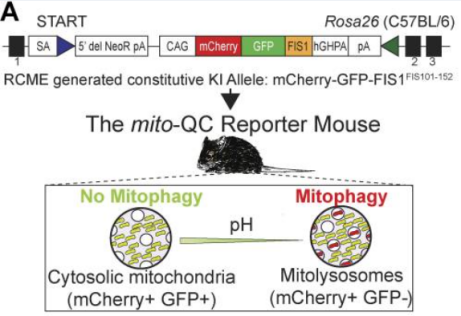
Fig. Schematic of gene targeting strategy used to generate the mito-QC mouse model[2].
工作原理
其核心在于利用溶酶体内部的酸性环境进行功能报告。
▪稳态下GFP和mCherry均能正常折叠发光,因此健康的线粒体呈现黄色(红绿叠加)。
▪当线粒体被自噬体包裹并与溶酶体融合后,其内部环境变为强酸性(pH约4.5)。pH敏感GFP立即发生荧光淬灭,而mCherry的荧光保持稳定(仅红色)。
信号解读
黄色点状或管状结构则为正常线粒体;独立的红色点状结构表明线粒体已递送至酸性溶酶体,即发生线粒体自噬。
主要作用
特异、直观地检测和定量线粒体自噬事件。这是目前体内外研究线粒体质量控制最强大的工具之一,尤其在活体组织(如大脑、肝脏)中优势明显。
优势
提供明确无误的自噬信号(红点),可实现自动化的高通量定量分析。
局限
它专注于“终点”。它能告诉你线粒体“是否已被送到降解工厂”,但无法揭示该线粒体在被降解前的“年龄”或功能状态。此外,极少数酸性细胞器(如分泌颗粒)也可能造成假阳性,通常需与溶酶体标志物共定位验证。
03
第三剑:MitoTimer — “时光沙漏”
核心元件:MitoTimer基于一种特殊的突变型绿色荧光蛋白。这种蛋白在新合成时发出绿色荧光,但随着时间推移,在细胞内氧化环境下会发生不可逆的构象变化,最终转变为发出红色荧光。将此蛋白融合线粒体靶向信号,即为MitoTimer[3]。
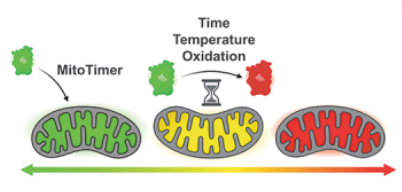
Fig.MitoTimer protein is synthesized and trafficked to the mitochondrial matrix where it fluoresces green. Upon maturation over time, fluorescence shifts from green to red. The mix of MitoTimer green and red protein in mitochondria creates a spectrum of protein dynamics for visua
工作原理
其本质是一个时间与氧化还原依赖的荧光转换器。
新生线粒体:线粒体生物发生时,新导入的MitoTimer蛋白呈绿色。因此,高绿/红荧光比区域标志着new线粒体。
老化/氧化线粒体:随着时间推移(数小时至数天),蛋白逐渐氧化转变为红色。高红/绿荧光比区域则代表old的线粒体。
关键提示:转换速率受局部活性氧水平调控。高氧化应激会加速绿转红的过程。因此,红色信号不仅代表old,也可能指示该区域氧化压力较高。
主要作用
可视化线粒体的生物发生、周转和区域化aging。它能回答:细胞哪个区域的线粒体更新更快;轴突末梢和胞体的线粒体age有差异吗;某种处理是否改变了线粒体的整体“新陈代谢”速率。
优势
提供了线粒体age的动态信息,是研究线粒体动态平衡和氧化应激的利器。
pMitoTimer
(Plasmid #52659)
Purpose
Expresses mitochondrial targeted DsRed1-E5 as reporter for mitochondrial content, structure, oxidative stress and damage in vitro and in vivo
Depositing Lab
Publication
Laker et al J Biol Chem. 2014 Apr 25;289(17):12005-12015. doi: 10.1074/jbc.M113.530527( How to cite )
Sequence Information

Ordering
This material is available to academics and nonprofits only.
| Item | Catalog # | Description | Quantity | Price (USD) | |
|---|---|---|---|---|---|
| Plasmid | 52659 | Standard format: Plasmid sent in bacteria as agar stab | 1 | $94 |
Backbone
Vector backbone
pDsRed2-Mito
Backbone manufacturer
Clontech
Backbone size w/o insert (bp)3959
Total vector size (bp)4658
Modifications to backbone
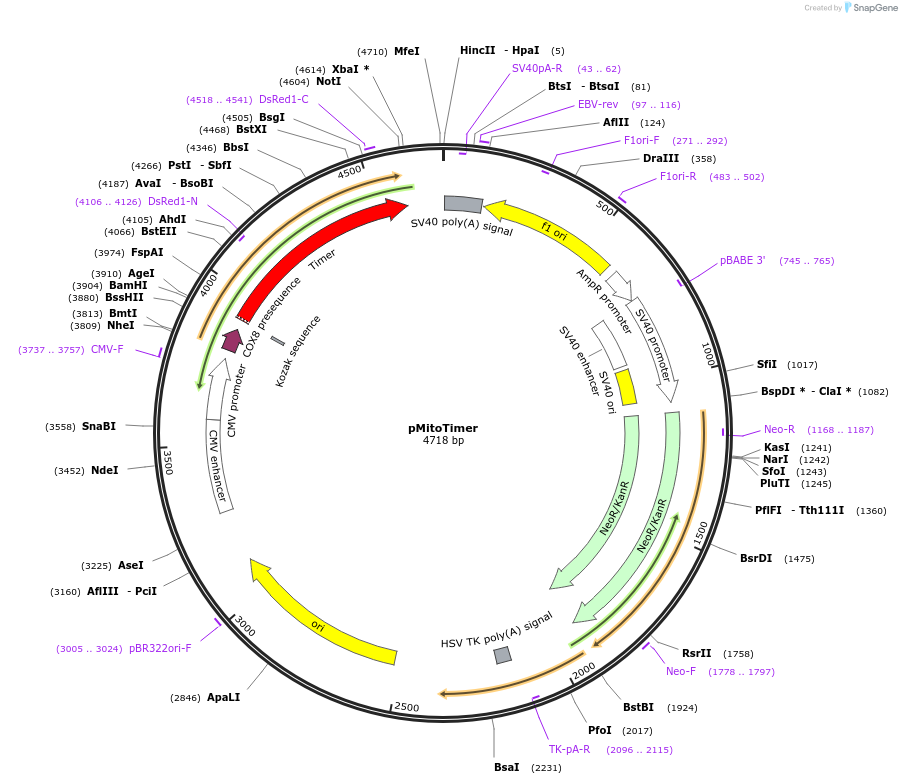
We constructed pMitoTimer by inserting the BamHI-NotI fragments of pTimer-1 (Clontech) into pDsRed2-Mito (Clontech) vector digested with BamHI and NotI using T4 ligase (New England Biolabs) following DNA isolation by using the Qiaex II gel extraction kit (Qiagen). The mitochondrial targeting sequence of the human cytochrome c oxidase subunit VIII (Cox8) gene from pDsRed2-Mito was then fused to the mutant DsRed1-E5 on the N-terminus.
Vector type
DsRed
Selectable markers
Neomycin (select with G418)
Growth in Bacteria
Bacterial Resistance(s)
Kanamycin, 50 μg/mL
Growth Temperature
37°C
Growth Strain(s)
DH5alpha
Copy number
High Copy
Gene/Insert
Gene/Insert name
DsRed1-E5
Alt name
Timer
Species
Discosoma
Insert Size (bp)
681
PromoterCMV
Tag / Fusion Protein
human cytochrome c oxidase subunit VIII mitochondrial targeting sequence (N terminal on insert)
Cloning Information
Cloning methodRestriction Enzyme
5′ cloning siteBamHI (not destroyed)
3′ cloning siteNotI (not destroyed)
5′ sequencing primerCMV-F
3′ sequencing primerSV40pA-R (5'-GAAATTTGTGATGCTATTGC-3')
Resource Information
A portion of this plasmid was derived from a plasmid made by
Clontech
Articles Citing this Plasmid
Terms and Licenses
Academic/Nonprofit Terms
Industry Terms
Not Available to Industry
Trademarks:
Zeocin® is an InvivoGen trademark.
How to cite this plasmid( Back to top)
These plasmids were created by your colleagues. Please acknowledge the Principal Investigator, cite the article in which the plasmids were described, and include Addgene in the Materials and Methods of your future publications.
For your Materials & Methods section:
